Investing in the stock market can be an exhilarating experience, but it can also be stressful, especially during times of sudden price fluctuations. To protect investors and maintain market stability, stock exchanges across the world use mechanisms called circuit breakers. In Nepal, the Nepal Stock Exchange (Nepse) has implemented its own system of circuit breakers to manage sharp market movements. In this blog, we’ll explore what circuit breakers are, how they work in Nepse, and why they are crucial for maintaining a stable stock market.

What Are Circuit Breakers?
Circuit breakers are essentially a market stabilizing tool designed to prevent extreme volatility in stock prices. They act like a safety valve for the stock market. Whenever there is a sudden surge or drop in prices, circuit breakers temporarily halt trading. This gives investors a chance to analyze the market situation, assess news, and make informed decisions instead of reacting impulsively.
The main objective of circuit breakers is to prevent panic buying or panic selling, which can otherwise lead to excessive price swings and potential losses. By introducing a temporary pause in trading, circuit breakers help maintain investor confidence and market integrity.
How Do Circuit Breakers Work in Nepse?
Nepse uses an index-based circuit breaker system, which means the mechanism is triggered based on movements in the overall market index rather than individual stocks. There are three levels of circuit breakers in Nepse, each corresponding to a specific level of index movement during the trading day.
| Movement | Time | Halt Period |
|---|---|---|
| ±4% | Before 12 PM | 20 minutes |
| ±5% | Before 1 PM | 40 minutes |
| ±6% | Before 3 PM | Entire day |
Here’s how it works in practice:
- First Hour Circuit (4% Movement):
If the Nepse index moves up or down by 4% in the first hour of trading (before 12 PM), trading is temporarily halted for 20 minutes. This gives traders time to process the news and avoid rash decisions. - Second Hour Circuit (5% Movement):
If the index experiences a 5% fluctuation before 1 PM, trading is paused for 40 minutes. This second-level circuit acts as a more significant measure against larger market swings. - Full-Day Circuit (6% Movement):
If the market moves 6% at any point during the day, trading is suspended for the rest of the trading session. This extreme measure prevents catastrophic losses and provides the market with a cooling-off period.
The Nepse circuit breaker system has been in place since 2007 and continues to play a vital role in controlling excessive price volatility and promoting market stability.
Circuit Breakers for Individual Stocks
Apart from index-based circuits, Nepse also has circuit-level trading for individual stocks. This mechanism limits the daily price movement of a single stock to ±10%. Here’s what you need to know:
- If a stock’s price rises or falls by 10%, it is referred to as positive or negative circuit trading, respectively.
- Unlike the index-based circuit, trading of individual stocks is not halted, even when the price hits the 10% limit.
- Once a stock reaches its circuit limit, its price cannot move further up or down, but trading continues. This helps investors plan their trades more strategically without extreme price swings for that specific stock.
Circuit-level trading is particularly useful for highly volatile stocks, ensuring that sudden price jumps or drops do not destabilize the market. It gives both small and large investors a level playing field by preventing extreme manipulations in stock prices.
Why Are Circuit Breakers Important?
Circuit breakers serve several critical functions in the stock market:
- Prevent Panic Selling and Buying:
During times of market turbulence, investors may react emotionally and sell or buy stocks impulsively. Circuit breakers pause trading and allow rational decision-making, preventing unnecessary losses or speculative bubbles. - Maintain Market Stability:
By controlling extreme fluctuations, circuit breakers help maintain a stable and healthy trading environment, ensuring that prices reflect true market conditions rather than panic-driven movements. - Provide Time to Analyze News:
Market-moving events, such as corporate announcements or global news, can impact stock prices dramatically. Circuit breakers give investors valuable time to process information and make informed decisions. - Protect Investor Confidence:
A stable and predictable market attracts both local and international investors. By limiting excessive volatility, circuit breakers enhance trust in the Nepse market. - Support Long-Term Investment Strategies:
Investors focused on long-term goals can benefit from reduced market chaos, enabling consistent portfolio growth without being affected by short-term irrational swings.
Example of Circuit Breakers in Action
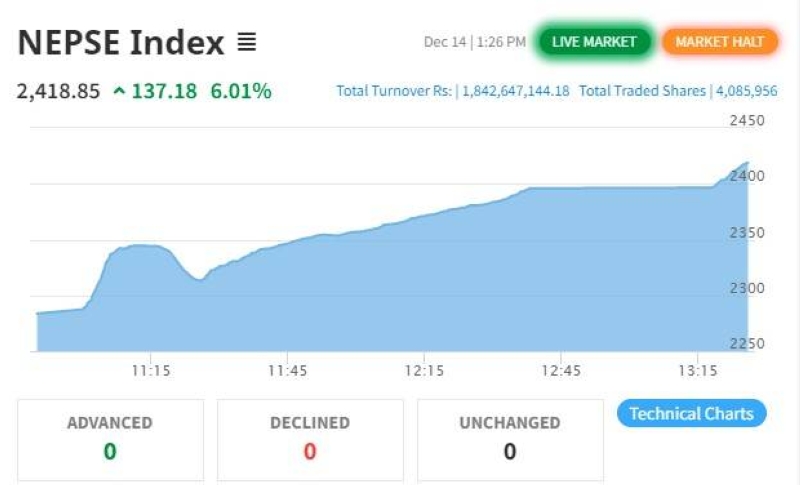
For example, on December 14, 2021, the Nepse index experienced a 6% fluctuation, triggering the highest-level circuit breaker. As a result, trading was halted for the entire day, giving investors time to assess market news and avoid panic-driven decisions. Such events highlight the importance of circuit breakers in maintaining an orderly and stable market.
Summary
Circuit breakers are an essential tool for Nepse and other stock markets globally. They are designed to control sudden price volatility, prevent panic selling or buying, and maintain market stability. In Nepse, index-based circuit breakers work on three levels: 4%, 5%, and 6% fluctuations, with corresponding trading halts ranging from 20 minutes to the remainder of the day. Additionally, individual stocks have 10% circuit-level trading, which limits daily price swings but does not halt trading.
By providing investors with a pause during extreme market movements, circuit breakers help create a healthier trading environment, improve investor confidence, and support rational decision-making. Whether you are a new investor or an experienced trader, understanding circuit breakers is crucial for navigating the Nepse market successfully.
Screenshot of Circuit Break in Nepse (Date: 2021/12/14)
Leave a Reply